Saturday, 4 February 2017

The Woodwose of Norfolk

I'm a Norfolk Humanist, but that does not stop me from enjoying the beauty, ingenuity and diversity of Church Art.  So many churches in Norfolk, and so much to discover.  Like Woodwose, for example.
The woodwose, woodhouse or woodwo, the wild man of the woods, was a popular mediaeval folklore figure, dressing in a lion's skin and in this case carrying a heavy club and shield -

The Ludham Woodwose.  There is also a very
rare carving of a female woodwose on this font.
I found two carvings of hairy men with clubs on the misericordia of Norwich Cathedral and took these pictures (with permission and on paying a small fee in the Cathedral shop). 

They are extraordinary images to find in a cathedral, and one can only speculate at the motives of the wood carvers.  Were they paying homage to older religions?  Were they hedging their bets with the Gods?


As you can see, the representations of "unregenerate" or unsaved man are not unsympathetic.  The figures seem healthy and well fed, even smiling slightly. What do they mean in their context?  Are they the secret messages of sceptics who could not otherwise express their doubts regarding the Christian message? 

Anton Wessels in his book "Europe:  Was it Ever Really Christian?" asks the same question from the Christian point of view, and acknowledges the strength of the Graeco-Roman, Celtic and even earlier influences, through enduring myths and legends still vivid even when Christianity was at its strongest.  

These woodwose are a joke, in my view, a wink from the past to fellow sceptics who do not take religion too seriously -


Thursday, 2 February 2017

Miracles on Elm Street?

The Curious History of Father Ignatius 1837 - 1908

By Nick Williams 
From Norwich Heritage, Economic and Regeneration Trust:

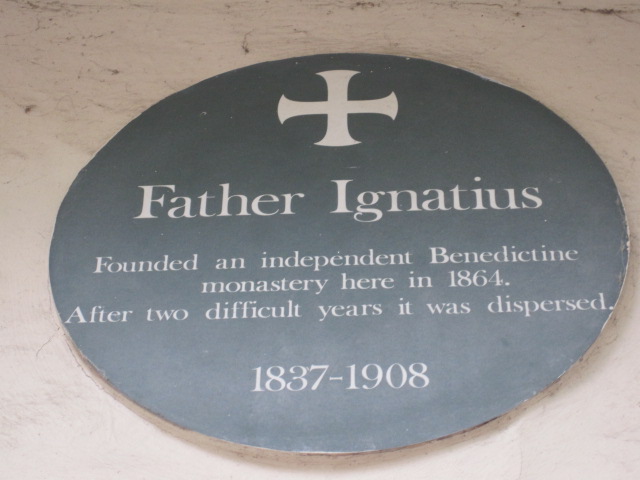
The plaque on the site of the short-lived Benedictine monastery

Joseph Leycester Lyne, later known as Father Ignatius, was one of the more colourful and controversial characters in the history of Norwich. A preacher and mystic he established a Benedictine monastery in Elm Hill in 1863. Within 3 years it had been closed amidst accusations of fraud and allegations of degenerate behaviour.

A fragile child

Born in London, one of seven children, Lyne was a fragile child who suffered ill health for most of his life, suffering repeated nervous breakdowns and bouts of what appears to have been nervous exhaustion. At school he was known by his fellows as 'saintly Lyne' but he appears to have had a mental strength and a precocious interest in spiritual matters. Whilst at St Pauls school he suffered a severe beating at the hands of 'an elderly clerical pedagoge' which resulted in a nervous breakdown with the perpetrator being dismissed from his teaching post by the school.

In 1856 he was accepted as a divinity student by Trinity College at Glenalmond in Scotland - the fees apparently paid by a female admirer after the refusal of his father to find the money. After leaving the college due to illness he subsequently held positions in churches in Scotland and Plymouth where he founded a monastic order known as 'the Society of the Love of Jesus' headed by himself with the title of Father Joseph. His behaviour brought him into conflict with the established church and with some of the parishioners. His stay at Plymouth ended following another bout of illness.

Following his recovery Lyne spent 9 months in 1862 at a church serving a poor area of east London. By now he had begun wearing a monk's habit and that along with his evangelical zeal, attracted opposition and support in equal measure. During his short stay in the east end there is a report of him confronting the customers of a rowdy public house declaring that 'We must all appear before the Judgement Seat of Christ'.

In 1862 he moved to Claydon, near Ipswich, where he established a Benedictine community in an unused wing of the rectory. The arrival of Lyne, now calling himself Father Ignatius, along with his preaching and proselytising provoked strong local reaction - including threats of violence. Within a few months of arriving at Claydon Father Ignatius was asked by the rector to leave.

The Elm Hill monastery

His next venture was the establishment of a Benedictine community as a monastery in Norwich later in 1862. They occupied a property on Elm Hill, described as being in poor condition and requiring much work to make it habitable; the building, number 14 Elm Hilll still stands. It was brought with the proceeds of a speaking tour throughout England and Wales undertaken by Ignatius. The house was purchased for £500, with a deposit of £50 being paid and the balance to be paid off in small instalments. The house became known as the Priory of St Mary and St Dunstan and opened in January 1863 when it accommodated Ignatius, one of his colleagues and a dog. Money being short, they apparently existed on a diet of bread and potatoes at first.

The preaching of Father Ignatius soon attracted support and donations to keep fed and clothe him and his colleagues. He also attracted opposition - particularly when he and his supporters processed to hold mass at the church of St Laurence on St Benedicts Street. Services at the monastery suffered from interruption from anti-Catholic elements. His stay in Norwich saw the attribution of miracles to him - reportedly including the curing of an epileptic, the ending of toothache and insomnia in a sufferer and the restoration of hair to a young boy. There was a less benevolent side to these 'miraculous events' as they also included the sudden and unexplained death of a woman who had blasphemed Father Ignatius as he passed by in the street.

The Benedictine community in Elm Hill continued to attract support - holding a parade through Norwich on Ascension Day in 1864 followed by a service on St Andrews Plain and a pilgrimage of some 400 people to Walstons Well outside Norwich. Work began on a new church building to hold these worshippers. This building became known as the Monastery Hall and exists today, standing between the Norwich School of Art & Design and the Monastery car park.


The Norwich Scandal

This progress was not to be maintained. In 1865 there were newspaper reports of a 'Norwich Scandal' featuring an inappropriate relationship between a novice monk and a young boy in the care of the monastery. There was further unfavourable publicity following an internal dispute about leadership of the monastery. Finally, in the spring of 1866, a disagreement over ownership of the monastery buildings saw the monastic community dispersed and the buildings sold, much to the chagrin of Father Ignatius who spent the next 12 years in a fruitless legal action to regain ownership. He also took more direct action, twice taking possession of the building, once gaining access by what he described as 'miraculous intervention'. But his actions proved fruitless as he was ejected on both occasions.


Door to the old monastery at 14 Elm Hill

He clearly retained some support in Norwich and returned to speak on several occasions - in March 1890 holding a mission service at the Agricultural Hall before preaching to 'a crowded congregation at the Church of St John de Sepulchre' in Ber Street. His last recorded public appearance in the city was in March of 1894 when he spoke to 'a crowded audience' at the Agricultural Hall.

Llanthony Abbey

Father Ignatius moved to London where, with the help of his female supporters, he established another Benedictine monastery in a house at Laleham, near Staines. Within 3 years, in 1869, he had bought land in south Wales where he built Llanthony Abbey - paid for by his supporters and the proceeds of his speaking tours.

He continued to attract controversy during his time at Llanthony until his death on October 1908. He was buried in the abbey grounds. The monastery remained open for only a short time after his death and subsequently fell into disrepair.

--------------------------------------------------------------------
Only wondering why such a man and his strange ministry is commemorated in Norwich.  Perhaps as the shortest-lived monastery ever?  But I'm glad he is remembered, it's a good story.   


Wednesday, 1 February 2017

Local hero John Hurt

In 2010 the acclaimed actor John Hurt told the Times:

I tend to read things about quantum physics and stuff like that — I don’t have a background in it, I try to understand it, I grapple with it. I don’t read for entertainment, I can’t see the purpose of that. 

Science is such an interesting area. It’s so fascinating to have lived in a period when religion has taken the thrashing it deserves. Not that it has entirely; we still have a few religions knocking around, doing exactly what they’ve done through the ages — which is f*** up everything.
In this cautious attitude towards religions, in his risk-taking and compassionate portrayals of controversial figures such as Joseph Merrick the "Elephant Man", and Quentin Crisp the "Naked Civil Servant", John Hurt was a Humanist.  In his zest for life and in his important patronage of local sports and arts, John Hurt was a great local Humanist.

Tribute from Craig Murray, once candidate for Norwich North:

Homosexuality was a criminal offence in the UK until I was nine years old. Attitudes towards gay people remained extremely hostile in much of society even after it was legalised for people over 21 in 1967. At school, I am sorry to say I shared to a large extent in the sneering and intolerant culture that was prevalent at that time.

In an age where there were just three television channels and nobody watched one of them, a new television play was a major event that could reach a mass audience in the way nothing can today. That is partly why Ken Loach had even more political effect with Cathy Come Home than with I, Daniel Blake. I am convinced that John Hurt’s towering performance in The Naked Civil Servant changed society. It brought the individual confrontations Quentin Crisp had engineered his entire life, and expanded them to confront half of the nation with the existence, and right to dignity, of gay people.

Of course Crisp himself was the hero, but John Hurt took a career threatening risk in taking the part and showed great courage and conviction. Hurt’s ability to manipulate the palette of courage, arch wit, and vulnerability that the role required gave the drama its impact, and propelled it with a shocking force I don’t believe any other actor could have managed.

I am not gay, but in a kind of solidarity I immediately adopted as a boy a number of Quentin Crisp’s mannerisms, including the long fingernails, hair and velvet jacket! I persisted with this for a great many years. A group of us at school adopted similar style, though I don’t recall ever discussing the Crisp influence. In 1978 I was delighted to meet Quentin Crisp, still pushing the boundaries by performing to a Dundee pub.

It was always a joy thereafter to see John Hurt appear in anything. We all have to die, and there is no point in getting maudlin about the death of celebrities. But I thought The Naked Civil Servant effect worth recording.

---------------------------------------------------------------------
The EDP reported 28th January that "Norwich supporters lead a mass applause at Carrow Road in tribute to Sir John Hurt"

(This) sporting tribute to the Hollywood star was announced on the Norwich City website. It said: 
Everyone at Norwich City Football Club was saddened to hear of the passing of Sir John Hurt at the age of 77.

Sir John lived in north Norfolk and became strongly affiliated with the Canaries, often cheering on the team at Carrow Road as a fan and as a guest of the directors.

The Bafta-winning actor also developed strong links in the local community as chancellor of Norwich University of the Arts and patron of Cinema City.
John Hurt's versatility as an actor is celebrated here.  He will be missed, not least in Norfolk for his humanistic values of tolerance for human diversity and mistrust of religion, and for his important work supporting sports and championing the Arts in Norfolk.


Tuesday, 31 January 2017

The Start of the Norfolk Humanists

BRIEF EARLY HISTORY 


We have to thank Philip Howell for the formation of the original group of Norfolk Humanists and Secularists.  In 1976 Philip wrote to the Eastern Evening News in response to letters from the ‘Save Religious Education’ Campaign.  Philip and others were against the religious indoctrination of children.  The British Humanist Association offered support and following a meeting at Philip’s home, it was agreed to form a Humanist and Secularist Group.  Later the group became affiliated to the British Humanist Association and the National Secular Society.

Vince Chainey was Chair of the Norfolk Humanists and Secularists until 2012. In 20
05 he gave an interview about his journey to Humanism. 

From BBC Norfolk : 

How I became a Humanist

It wasn't until I was in my mid-fifties that I realised I was a Humanist - and had unknowingly been a Humanist since my teens.

My parents were not particularly religious, although probably believed in a God and an afterlife as did most of their generation, so they sent me to a Church of England school.

I was a choirboy and my vicar talked me into becoming the server at our local church, being the boy to carry the cross in front of the choir and then helped the vicar at the altar.

I soon realised that the correctness of the ritual was more important to him than the compassion, which I, as a young sensitive caring lad had been led to believe was religion.

Rejecting religion

I looked at other religions and became interested in science, evolution, and astronomy, as well as history which showed me that religions had been the cause of much anguish and wars, so I rejected religion.

It wasn't until I was in my fifties that a colleague died and his family organised the usual Church of England funeral.  I was so disgusted that the vicar had said nothing about his achievements in life or his wonderful character and only talked about God and an afterlife - everything that my friend did not believe in.

A year later I attended a Humanist funeral ceremony and was so impressed by the contrast.  I enquired more about Humanism and realised I had been unknowingly a Humanist since my teens.


I joined the local group which has been going for the past 30 years and has about 50 members which is democratically run by a committee elected yearly.


Vince Chainey 2004

What it means to be a Humanist


Humanism is a life stance for those who can no longer believe in the various mythical religions of the world, but are willing to base their conviction on respect for human kind as moral beings.

It is a philosophy of life based on rational, logical reason, and our common humanity and advocates the application of scientific method to solve the problems of human welfare and our happiness, rather than relying on dogmatic ancient religions which divides societies.

On a practical level, many people find it hypocritical to go through a religious ceremony when they live their lives without religion.

There are humanist groups all over the country with trained, accredited officiants who perform dignified non-religious funerals, memorials, weddings, same sex affirmations and baby naming ceremonies.

These are widely respected and are evermore popular as society is becoming more secular with over a third of the population now non-religious.

Ethical and moral code

Humanists believe that people can live a happy, just, and fulfilling life based on an ethical and moral code, without worshipping a supernatural god or believing in the promise of a better after life, or the threat of eternal punishment for disbelief.

We have a concern for humanity, as well as for all other creatures and the environment. As this is our only life, we should do all we can to make it happier and better for everyone.

We recognise that moral values have evolved with human society to be the best way for humans to live together on our planet. They are founded on human nature and experience alone and not given to us by a supernatural being.

Open society

We accept and value freedom of thought in an 'open society' and campaign against religious privilege, and the connection between national government and state church, collective worship in schools, and that religious education should be balanced to include all world philosophies and religion.


Humanist groups are affiliated to the British Humanist Association which was formed just over 100 years ago, but is not a mass membership organisation.

_________________________________________________

From the Norfolk Humanists 2013:

The Norfolk Humanists said a fond farewell to Vince Chainey in 2012 as he was moving away from Norfolk.


Vince Chainey 2012
As a Celebrant Vince conducted over one thousand celebrations.  The Norfolk Humanists thanked Vince for all his hard work both as Chairman and as a member.  Vince will be much missed.

Today the group is known as the Norfolk Humanists (for the sake of brevity and considering Secularism is an intrinsic part of Humanism). We have lively meetings on a variety of interesting topics, and maintain a busy and fully interactive Facebook page.


The local group meet in Norwich every two months, as advertised on our website

We have guest speakers and discussion evenings as well as social events. We hold exhibitions and campaign against religious privilege, but do not evangelise.

If you would like to enquire about becoming a member of the Norfolk Humanists, 
please email us from the website or fb page.

If you would like to find a local celebrant, please try here.

_____________________________________________

Fact File

-  According to the 2001 census, at least 15.5% of the population is non-religious, making this the second largest "belief" group in the UK.


- According to the 2011 UK Census, those of no religion are the second largest belief group, about three and a half times as many as all the non-Christian religions put together – at 26.13% of the population. 16,038,229 people said they had ‘no religion’ with a further 4,406,032 (7.18%) not stating a religion. 58.81% described their religion as Christian and 7.88% as some non-Christian religion. This represented a massive change from the 2001 Census, where 15.5% of the population recorded having no religion, and 72% of the population reported being Christian.

- The Humanist vision is 
A world without religious privilege or discrimination, where people are free to live good lives on the basis of reason, experience and shared human values.
-  Humanists trace their roots to the rational philosophy first created in the West in ancient Greece. Many regard Socrates as the first and greatest of the Humanists.


Wednesday, 25 January 2017

Will Racism End When Old Bigots Die?

By Leah Donella in CodeSwitch January 14:
Esther Lui for NPR

Shelly Fields is a 46-year-old white woman living in Richton Park, a racially diverse Chicago suburb. She says she's raised her four daughters, who are biracial, to see people of all races as equal, just as her parents raised her. Fields doesn't think that racism will ever disappear completely, but she's hopeful that it lessens with each passing generation. Fields said:

The more biracial children there are, the more equality we see.  The more people of color we see in positions of power – it will help to change the way people see race.
Her oldest daughter, Summer, is a 22-year-old graduate of the University of Chicago. When she was in high school, Summer probably would have agreed that race relations were looking up. The '90s and early 2000s were "a post-racial fantasy time" in Richton Park, Summer said. "Being firmly in the middle of the Obama era – it [was] a moment of progress. It was validating."

Now, as the Obama era ends, she is of the mind that racism isn't going anywhere.

"Racism always evolves, and will find a way," Summer said.

The question that Shelly and Summer are tackling has been posed in many forms for many generations. Will racism just die off with old bigots? Does the fate of race relations lie with the children?

That idea has been milling about the public psyche for generations. It lives in that famous (if oft-decontextualized) line: "I have a dream that my four little children will one day live in a nation where they will not be judged by the color of their skin but by the content of their character."

Martin Luther King, Jr. said it eloquently in his "I Have a Dream" speech, but we've heard that sentiment through the ages, from Thomas Jefferson to Oprah Winfrey. The belief that our children's generation will be less racist gets repeated by teachers, parents, politicians and activists. And understandably so. Much of American culture is predicated on the idea that we can create a better future for our progeny, instilling in them values that we as a nation have often failed to uphold.


Shelly and Summer Fields.Courtesy of Summer Fields

In our small, very unscientific survey last month, Code Switch heard that conviction. We also heard just the opposite. We wanted to know if beliefs about the future of racism were held consistently in families from generation to generation. Here's what we asked in our December callout: Will racism fade away when old bigots die?

Of the 120 or so people who responded, more than two-thirds said they did not think the next generation would usher out racism. And nearly the same number thought their answer would differ from their parents or grandparents. (There's reason to think, given some more scientific national research, that there's not really much difference between generations when it comes to racial beliefs.)

But let's get back to the Fields family. Summer Fields responded to our survey. She had no qualms saying that racism would be with us for the long run. She didn't know exactly what her mom would say, but she was pretty sure it wouldn't be that.

Here's what Shelly said: 


The further we get away from the idea that one skin color or race is better than the other, the better. Past generations had these ideas, and they were spread to the next generation and the next.
Shelly learned about race from her parents. When she was growing up, she said, they taught her never to judge other people based on skin color. That didn't stop them from being cautious when she began dating outside her race and eventually decided to start a family with a black man. Shelly said:
Once [my mother] found out I was pregnant, when it hit close to home, it was a different story.  She was afraid ... She said, 'You're gonna have a baby with dark skin and kinky hair.'

She was afraid because she didn't know [what to expect]. And I really didn't know either.

But Shelly said that once her daughters were born, her parents were able to see firsthand that there was nothing to worry about. (She lives right behind her parents, and they've been heavily involved in each other's lives.) She said that her neighborhood has always been racially mixed, and that her family has never really experienced racism there. That, she said, helped her parents move past some of their fears and double down on their belief that people of all races should be treated equally. Shelly said:


They taught that to my daughters. They and I showed my daughters, and I'm hoping that they'll show their daughters and sons.
Summer isn't quite as hopeful. As a high schooler, being surrounded by a mix of black, white, and multiracial classmates, it was possible for her to believe in a more uplifting future. After arriving at the University of Chicago, where less than five percent of the student body was black, her perspective changed. She started learning about things like race theory in her classes. The overwhelmingly white environment also affected how she thought of herself; her identity suddenly felt more political.

She found herself engaging and disagreeing more with her mom's ideas about race. They've argued over things like trigger warnings and safe spaces (her mom says that's not how the real world works) and about how to self-identify. Summer thought of herself as biracial until she went to college. When she started referring to herself as a black woman, that became another point of contention.

"My mom doesn't understand," she said. "She feels like that's an affront to her."

While Shelly knows racism won't disappear ("We still have families that teach the same things they were taught about judging people based on race," she said,) she holds onto some optimism.

Summer's prognosis is a little bleaker.

Our country's whole identity is founded on the pillaging and murder of Native people and chattel slavery.
 She said. It would help to acknowledge that, she said. She's just not sure democracy could handle it.
For us to call that out and admit it would be the first step. But it would destroy the whole project.
That generational dissonance seemed to be a common thread among the people we surveyed. We heard from a South Asian college student in Florida who said that because her parents chose to come to the United States, they're more invested in the notion that America is a land of opportunity for all people. So they don't get why so many people of color in this country fear police or don't work their way out of poverty.
My mom isn't racist ... but she doesn't understand institutional racism. I have an understanding of [American] history that my parents don't.
University of Florida student

We also heard from a white elementary school teacher in New Jersey who's hopeful because his white students idolize musicians and athletes of color. But he said his parents think the culture gaps between races are too large to ever overcome. At one point, he spoke to them about moving from his largely white neighborhood into one that was racially mixed. He thought he'd be comfortable there.

Their response?

"No, you wouldn't."

Much of the available public polling data suggests that millennials like the schoolteacher are not as different from Generation Xers or Baby Boomers as they might think. Kathleen Weldon, communications director at the Roper Center for Public Opinion Research at Cornell University, said millennials tend to say they are more optimistic about race relations than their parents, and more broadly accepting of things like interracial friendships and marriage.

But when questioned about specific policy issues tied to race, she said, millennials sound a lot like their elders. They don't "have different views on the [George] Zimmerman case, aren't more aware of the disproportionate effect of HIV on the black community, are not more likely to think government should play a major role in the social and economic position of blacks, and are no more [or less] likely to think the [Voting Rights Act] is still necessary," Weldon said.

In other words, when it comes to perceptions and policy around race in the U.S., young Americans don't look much different from older ones.
Jocelyn Wilks and her father, Elijah, expected their views to diverge significantly when it came to race and racism. But though they come from different generations, were born in different parts of the country, and even have different ideas of what they'll call racism, their outlook is pretty similar.

As a black man born in Mississippi in the early 1960s, Elijah lived with state-sponsored racism. He was in fourth grade when his school integrated. When he was in high school, there was a black homecoming court and a white homecoming court, a black "Mr. and Miss High School" and a white "Mr. and Miss High School."


Jocelyn and Elijah WilksCourtesy of Jocelyn Wilks

Those experiences inform his thinking about race. His daughter, he said, formed her opinions another way. Elijah said:

I've never taught [Jocelyn] about racism, I never had those conversations with her. I let her grow up and develop her own opinion of things. That was never taught in the home when I was growing up and I didn't teach her that way.
Another difference between father and daughter, he said, is geographic. He was raised in Mississippi; Jocelyn was born and raised in San Antonio. Elijah said:
Where I grew up, you were either black or white. In San Antonio, it's predominantly Hispanic, and whites and blacks are minorities ... It makes a huge difference.
Jocelyn is a 28-year-old accounting student who lives just north of San Antonio. Her experience teaching pre-school helped convince her that racism was going nowhere fast. During that time, Jocelyn heard a lot of nonsense from her students, like one boy who, after losing a basketball game, said his opponent's "genes were made to jump." Jocelyn knew the children were getting those ideas from somewhere. She said:
When you're 9 or 10 you can't call bullshit on your parents. You take those racist statements as facts. ... Kids pick up things that you don't teach them. So if Mom treats a person of color poorly, the kid sees that and picks it up, because that's their model.
Jocelyn said she and her dad have different ideas of what's worth labeling racism. Born in a harsher time, his threshold, she said, is higher.
It won't be the small slights that people in my generation find to be racist. He thinks things are getting better, and they are better from when he was growing up. But it's not the better that we're looking for. He wouldn't look at gentrification or housing segregation and say, 'They're doing that on purpose, this is racist.' It would be a church shooting, and he'd [say], 'That's a hate crime.'

Dad says, 'It's not fair that these people are getting killed and no one's going to jail for it.' And I say, 'It's not fair, if your name is Shaniqua, that you have to work 15 times harder to get a job than anybody else.'

But when they come back to that question that has been passed down through the generations – Will racism fade away when old bigots die? – Elijah and Jocelyn sound almost identical.

Father: "As new generations come into existence, it will be lesser and lesser, but I don't know if it will ever end."

Daughter: "As long as there's racism in this generation, there's going to be racism in the next generation. It might dwindle, but it won't disappear."


Saturday, 21 January 2017

Call for a secular state

The need for a secular state “has never been greater”, says new report

From the National Secular Society:

A secularist report produced by academics and campaigners has urged the Government to reject calls for more religious privilege.

In late 2015 the Woolf Institute's Commission on Religion and Belief (CORAB) in Public Life published a report which made sweeping recommendations on the role of religion in Britain, with proposals that would have given minority faiths similar privileges to those enjoyed by the Church of England, including seats in the House of Lords.

Just one of CORAB's twenty-one commissioners was from a non-religious organisation and many groups, including the National Secular Society, declined to submit evidence to the Commission over concerns about its unrepresentative membership.

Academics, secularists and campaigners have now produced "A Secularist Response" to the Commission's findings, drawn up by Dr Steven Kettell at the University of Warwick, and based on the deliberations of an expert panel which met last year.

Dr Kettell wrote that the flaws in the CORAB report "are evident from the outset."

Despite acknowledging the decline of religion, along with the rise of non-religion and the growing diversity of religion and belief in Britain, CORAB sought to promote an enhanced and more prominent role for faith in British public life.

Secular voices were also given insufficient weight.

With a growing proportion of Britons now identifying as non-religious, and with levels of cultural pluralism and diversity on the rise, the need for a political and legal system capable of giving equal weight and recognition to all citizens has never been greater.
CORAB's 37 recommendations were "at odds with the realities of modern British society," the response says, and a new path is needed to recognise growing pluralism, diversity and secularisation.

Instead of the multi-faith approach taken by CORAB, the secularist response advocates "a secular state, impartial to all systems of religion" to guarantee "equality for all citizens" and as "the best mean of fostering a free, inclusive and democratic society".

No religious group should be given "an automatic right to representation in Parliament," the response says, in contrast with the Woolf Commission's call for imams and rabbis to join Anglican bishops.

Dr Kettell's response echoes recent proposals made by the National Secular Society in its new report, 'Rethinking religion and belief in public life: a manifesto for change', which also rebutted recommendations made by the Woolf Commission.

Where the Woolf Commission did make nods towards secular reforms, in line with Britain's largely irreligious population, they were typically limited in scope and practicality. On faith schools, the Commission simply said that leaders should "take measures to reduce selection of pupils and staff on grounds of religion".

Both Dr Kettell's response and the NSS' manifesto call for an end to faith schools.

CORAB "fails to engage" with the debate around religion and education, Dr Kettell wrote and neither justifies the presence of faith schools in the state sector, not provides "any empirical evidence in defence of faith schools themselves."

The new secularist response also said that current levels of support for faith schools looked "set to unwind as the secularisation of British society increases and as the intake of faith schools themselves becomes increasingly secular", a situation which is "likely to become increasingly untenable."

Speaking at the Report's launch at London's Shard, National Secular Society executive director, Keith Porteous Wood, said: 
The need to implement the noble secularist principle of equality for all irrespective of religion or belief becomes all the more pressing as society becomes less religious and more diverse. But too many institutions seem hell-bent on obstructing that equality.


Tuesday, 17 January 2017

The urgent need of full global access to birth control

By Joe McCarthy Global Citizen:

It will take an estimated $8.1 billion annually, a bargain when you consider it could keep the global population from growing a few billion in size.

Currently, there are 7.4 billion people on Earth. By 2100 there could be 12.3 billion humans.

That’s not just an extra 5 billion people in today’s terms. As the global middle class grows, people demand more meat, more clothing, more cars, more air conditioning, and more. All of this limits how much the Earth can create annually.

Already, humans take out more resources each year than the Earth can credibly replenish. It’s putting a strain on everything from fish populations to grape fields and it’s pushing the world into what scientists are calling the 6th extinction.

So can anything be done to address this?

Well, a once-trendy (if controversial) idea is being dusted off as a solution. To combat the frightening rise in consumption, many conservationists are calling for population control.

If population growth slows, the argument goes, then we can solve existing problems, rather than face even worse problems.

Theoretically, this wouldn’t be hard to accomplish.

The first step would be providing universal and always-available contraceptives to people, especially women.

Right now, 800 million women who want contraceptives cannot get them. In developing countries, the rate of women deprived of contraceptives can be as high as 60%.

If access to contraceptives is provided to developing nations, the effect would be tremendous. From 2011 to 2012, the developing world accounted for 97% of global population growth. The developing world is also experiencing the sharpest increase in consumption patterns.

Of course, you can’t simply airdrop supplies. There has to be a coordinated educational effort and support system that teaches the usefulness of birth control and challenges cultural norms that stand in the way to adoption.

To accomplish this, it will take an estimated $8.1 billion annually, a bargain when you consider it could keep the global population from growing a few billion in size. As a comparison, it will cost nearly $30 trillion for the world to fully switch to renewable energy, according to one estimate.

The next, longer-term step involves broader female education and empowerment.

According to Niki Rust and Laura Kehoe for Quartz, “By simply providing better female education, the overall population in 2050 could be 1 billion less than current projections.”

This makes sense when you think about it.

When a girl receives a full education, she is more likely to delay marriage, invest in her career and appreciate the value of independence. She is also more likely to understand the importance of birth control and how to navigate the barriers that prevent her from obtaining it.

Underlying all of this is not a desire to suppress family size. Instead, it’s a belief that environments around the world can be best conserved through population control.

By suspending the amount of resources that people need, the strain put on the Earth can stay flat and other solutions—like reforestation and renewable energy technologies—can be more effective as a result.

There are critics who say the benefits of population control can only be realized many, many generations down the line. They argue that the momentum of growth has become too steep for birth controls to have immediate effects, and by the point they do make a difference, it will be too late.

Also, population may not even be the main driver of consumption. Rising affluence could be the chief culprit, something that will increase with or without checks on population.

In this case, cities that are more efficiently designed, a shift toward plant-based diets and ending fossil fuel dependence should be the primary goals.

Regardless, it seems clear that population control has to be a part of any global plan to combat environmental degradation and climate change.

There’s only so much space on this planet, and humans are not the only creatures that have a rightful claim to some of that space.


Monday, 16 January 2017

'Race' is a Social Construct

What Scientists Mean When They Say ‘Race’ Is Not Genetic
A new paper explains why it can be dangerous to think otherwise.

By Jacqueline Howard Senior Science Editor, The Huffington Post


STOCKBYTE/GETTY IMAGESRace is a social construct, researchers say.

If a team of scientists in Philadelphia and New York have their way, using race to categorize groups of people in biological and genetic research will be forever discontinued.


The concept of race in such research is “problematic at best and harmful at worst,” the researchers argued in a new paper published in the journal Science on Friday.

However, they also said that social scientists should continue to study race as a social construct to better understand the impact of racism on health.

So what does all this mean? HuffPost Science recently posed that question and others to the paper’s co-author, Michael Yudell, who is associate professor and chair of community health and prevention at the Dornsife School of Public Health at Drexel University in Philadelphia. 

Why is it problematic to view race as a biological concept?

For more than a century, natural and social scientists have been arguing about whether race is a useful classificatory tool in the biological sciences — can it elucidate the relationship between humans and their evolutionary history, between humans and their health. In the wake of the U.S. Human Genome Project, the answer seemed to be a pretty resounding “no.”

In 2004, for example, Francis Collins, then head of the National Human Genome Research Institute and now director of the National Institutes of Health, called race a “flawed” and “weak” concept and argued that science needed to move beyond race. Yet, as our paper highlights, the use of race persist in genetics, despite voices like Collins, like Craig Venter — leaders in the field of genomics — who have called on the field to move beyond it. 

We believe it is time to revisit this century-long debate and bring biologists, social scientists and scholars from the humanities together in a constructive way to find better ways to study the ever-important subject of human diversity.

The race concept should be removed from genetics research for the following reasons: Genetic methods do not support the classification of humans into discrete races, [and] racial assumptions are not good biological guideposts. Races are not genetically homogenous and lack clear-cut genetic boundaries. And because of this, using race as a proxy to make clinical predictions is about probability.

Of course, medicine can be about best guesses, but are we serving patients well if medical decisions are made because a patient identifies as part of a certain racial group or are identified as belonging to a specific race? What if, for example, the probability is that if you are white you are 90 percent likely to have a beneficial or at least non-harmful reaction to a particular drug? That sounds pretty good, but what if you are that 1 in 10 that is likely to have a harmful reaction? That doesn’t sound so good, and that is the problem with most race-based predictions. They are best guesses for an individual.

We also believe that a variable so mired in historical and contemporary controversy has no place in modern genetics. Race has both scientific and social meanings that are impossible to tease apart, and we worry that using such a concept in modern genetics does not serve the field well.
We hope that our paper spurs scientists to rethink the use of race in human genetic research.
Michael Yudell, researcher in the fields of ethics, genomics and public health

Based on your research, what is race?

Genetics has long struggled with the definition of race. In the first decades of the 20th century, race was defined by discrete types, the belief that one member of a race was thought to share the same physical and social traits with other members of that race. In these early ideas about race, races generally mapped onto continental populations. Beginning in the 1930s, with the rise of modern population genetics and evolutionary biology, race was reimagined in the context of evolutionary biology and population genetics. Instead of racial groups being fixed between continents, the race concept was a way to understand the frequency of individual genes in different human populations.

In this way, race was a methodological tool that biologists could utilize to study human genetic diversity that did not reflect an underlying hierarchy between human populations. This was simply about gene frequencies between groups. And it is this understanding of race that is still largely the way modern science understands the term.

But the scientist who helped rethink race in the 1930s and 1940s — the great evolutionary geneticist Theodosius Dobzhansky, a Russia-trained scientist who spent most of his career at Columbia University — would later in his career voice concern that the use of the race concept in biology had “floundered in confusion and misunderstanding.

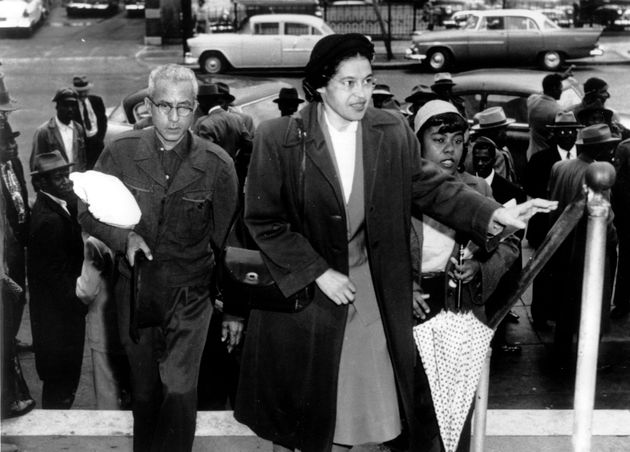
ANONYMOUS/APRosa Parks, known as as the “mother of the civil rights movement,” arriving at circuit court 
to be arraigned in the bus boycott in Montgomery, Alabama, in 1956.


In the 1950s, Dobzhansky was moved by factors, both internal and external to science, to call into question the utility of racial classifications. The rise of the civil rights movement, the appropriation of biological conceptions of race to counter civil rights advances, and his own disputes with colleagues over the imprecise and sometimes inappropriate use of the term race led him to call on biologists to develop better methods for investigating human genetic diversity.

The problem today is that modern genetics is stuck in a paradox that reflects Dobzhansky’s own struggle with the race concept: both believing race to be a tool to elucidate human genetic diversity, and believing that race is a poorly defined marker of that diversity and an imprecise proxy for the relationship between ancestry and genetics. This paradox is rooted in the nature of the field. Like Dobzhansky, we and many others in genetics, anthropology and the social sciences have called on scientists to devise better methods to improve the study of human genetic diversity. The field is still trying to respond to Dobzhansky, and we hope that our paper spurs scientists to rethink the use of race in human genetic research.

Race also, of course, has social meanings. And by suggesting that race is not a useful tool for classifying humans, we do not mean to say that somehow race is not real. Race is, of course, real. We live in a country and a world where skin color has long been used as a way to systematize discrimination and brutality.

But that is not what we are arguing in this paper. We are arguing simply that race is not a useful tool to study human genetic diversity and that there is potential harm in doing so. We acknowledge in the paper that using race as a political or social category to study racism and its biological effects, although fraught with challenges, remains necessary.

For example, we need to continue to study how structural inequities and discrimination produce health disparities between groups. Your race can impact your health, but your genetics is not a good window into how race affects your health. This line of thinking goes all the way back to the sociologist and civil rights pioneer W.E.B. Du Bois. Du Bois was the first to synthesize data from anthropology and the social sciences to conclude, for example, that race-based disparities stem from social, not biological, inequalities.

How would you explain some of the differences that we see between various groups and the prevalence of certain genetic diseases, such as sickle cell anemia in the African-American community?

That’s a great example. Sickle cell is not an African-American or African disease, although it occurs in higher frequency in these populations. But this is not a racial difference; it is a matter of ancestry, geography and evolution. Sickle-cell occurs in higher frequency in populations from regions of the world where malaria is or once was common, as sickle cell is a disease that is an evolutionary adaptation to exposure to malaria.

The sickle-cell trait is believed to be protective against malaria. Thus, sickle-cell disease is at its highest frequency in West Africans and people of West African descent. But this trait is not common in other regions of Africa, where malaria is not as prevalent. Therefore, it is not an “African” disease. Sickle cell also appears in other regions of the globe, in other human populations, including populations in the Mediterranean Basin, the Arabian Peninsula, and on the Indian subcontinent, where these populations also saw this adaptation to resist malaria. 

How is race currently used in genetics research?

Race is used widely in human biological research and clinical practice to elucidate the relationship between our ancestry and our genes. In the laboratory, race can be used to investigate disease-causing genes within and between populations, and, more generally to classify groups in studies of human populations. Race is also used clinically to inform decisions about a patient’s risk for certain diseases and to help predict how one might metabolize drugs.

Some scientists have argued that relevant genetic information can be seen at the racial level; that race is the best proxy we have for examining human genetic diversity. Other scientists have concluded race is neither a relevant nor accurate way to understand or map human genetic diversity. Finally, others have argued that race-based predictions in clinical settings, because of the heterogeneous nature of racial groups, are of questionable use. So, despite a widespread use of race in scientific and clinical research, race is the most controversial tool for making sense of human diversity that scientists have at their disposal.

We would prefer the field of genetics use concepts like ancestry instead of race in human studies. It is important to distinguish ancestry from race. Ancestry is a process-based concept that helps us understand the admixing events that lead to one’s existence. Ancestry is also a statement about an individual’s relationship to other individuals in their genealogical history. Thus, it is a very personal understanding of one’s genomic heritage.

Race, on the other hand, is a pattern-based concept that has led scientists and laypersons alike to draw conclusions about a hierarchical organization of humans, connecting an individual to a larger, preconceived, geographically circumscribed or socially constructed group.

Your race can impact your health, but your genetics is not a good window into how race affects your health.

Michael Yudell, researcher in the fields of ethics, genomics and public health

With that being said, are some of the biological concepts of race used in genetics research examples of scientific racism?

Unlike earlier disagreements concerning race and biology, today’s discussions generally lack clear ideological and political antipodes of “racist” and “non-racist.” Most discussions today about race among scientists concern examination of differences between groups with the goal of understanding human evolutionary history, and the relationship between our genes and our health with the goal of determining the best course of medical treatments. However, this doesn’t mean that the race concept in biology can’t be used to support racism.

An example of this is the concern many had in the wake of Nicholas Wade’s book A Troublesome Inheritance, which made claims about the genetic basis of social differences between races. Wade’s book forced a large group of leading genetics to publicly refute the idea that genetics supported such ideas. Other examples include outrageous and incorrect claims about the relationship between race, genetics and intelligence.

What will it require to take race out of human genetics?

Well, we make two proposals in our paper. The first is that we call upon journals to encourage the use of alternative variables to study human genetic diversity and to rationalize their use. Journals should require scientists publishing in their pages to clearly define how they are using such variables in order to allow scientists to understand and interpret data across studies and would help avoid confusing, inconsistent and contradictory usage of such terms. This has been tried before, but only in piecemeal fashion, making sustained change unfeasible.

We also recognize that the use of terms changes nothing if the underlying racial thinking remains the same. But we believe that language matters and that the scientific language of race has a considerable influence on how the public understands human diversity.

Second, we are calling upon the U.S. National Academies of Sciences, Engineering, and Medicine to convene an interdisciplinary panel of experts to help the field improve the study of human genetic diversity.

As an honest broker in science policy, the Academies can play a constructive role in bringing together natural scientists, social scientists and scholars from the humanities to find ways to study human genetic diversity that do not recapitulate the confusion and potential harm that comes with using the race concept.


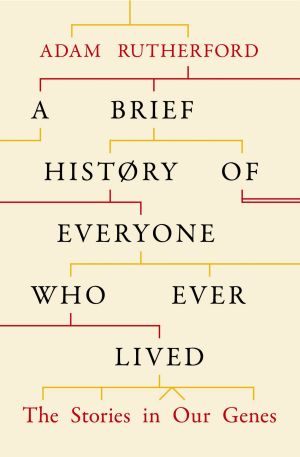
A Brief History of Everyone Who Ever Lived

Adam Rutherford's new book, on the miracle of human genetics, is not merely informative, but wise.

By Andrew Mueller from New Humanist:


This article is a preview from the Winter 2016 edition of New Humanist. You can find out more and subscribe here.

A Brief History of Everyone Who Ever Lived: The Stories in Our Genes (W&N) by Adam Rutherford

The odds against you existing are astonishing. Every person reading this – every person not reading this, for that matter – is the consequence of a chain of meetings and matings reaching back over aeons. We can probably afford to be a little forgiving of those who, contemplating such awesome improbabilities, perceive the qualities of miracle.

Adam Rutherford’s A Brief History of Everyone Who Ever Lived is his second book-length fathoming of the unfathomable, following 2013’s excellent Creation: The Origin of Life / The Future of Life. In both books, Rutherford is an engaging and accessible narrator, able to deploy his expertise as a torch with which to illuminate a complicated subject. He is also often very funny, alive to the absurd lengths to which humans are willing to go in order to disbelieve the facts.

Rutherford’s particular expertise is genetics, and his purpose in A Brief History of Everyone Who Ever Lived is twofold. First and foremost, to provide a layperson’s guide to the basics of, and recent advances in, his field. Secondly, to demonstrate that almost everything on the subject that one might read in the popular press is at best lazily misconstrued, and at worst wilful, meretricious hogwash. On the latter subject, there is surely a case that poor science reporting is a worse journalistic felony than poor political reporting, as science, unlike politics, is not a realm in which the facts can be altered by opinions. The magnitude of the problem is neatly illustrated in the paragraphs in which Rutherford recalls being taken to lunch by a TV producer working on a programme pondering whether humans will ever evolve to be capable of unassisted flight. Spoiler alert: they won’t.

Rutherford’s core message here – and he is well entitled to the weary, sighing “despite what you may have read” in the introduction – is that genetics, especially recent research into DNA, is not destiny. It will not tell you whether you, or your children, are more or less likely to turn out genius or dunce, gay or straight, conservative or communist, astronaut or trouser-press salesman, upright citizen or chainsaw murderer. It will, however, tell you a great deal about who you are, and how you got here.

This is, inevitably, a singularly ripping yarn. Rutherford superbly narrates not merely our species’ progress from our original African heartland, but also the discoveries and advances which have allowed us to map that journey retrospectively. He has a keen eye for the arresting factoid that underpins the broader concept: any reader with even a smattering of European ancestry will be able to henceforth assume the airs and graces of royal descent upon absorbing Rutherford’s explanation of how they are almost statistically certain to be literally descended from Charlemagne.

Most useful is Rutherford’s elegant demonstration that notions of differing genetic predisposition to qualities or defects among races are nonsense: Native Americans have no inbuilt tendency to alcoholism, a Jew is no more likely to suffer “the Jewish disease”, Tay-Sachs syndrome, than a French Canadian, black people are not innately superior athletes. It can only warm the humanistically inclined heart that the more we learn about our origins and our make-up, the clearer it becomes that any tilt in the playing field was built by us, and is therefore ours to dismantle.

A Brief History of Everyone Who Ever Lived is not merely informative but wise. It may well be that the sheer mind-boggling unlikeliness of our genesis, both as a species and as individuals, is what has driven successive generations of humankind to construct elaborate mythologies insisting that we are the carefully wrought masterpiece of some omnipotent creator, rather than the beneficiaries of a cosmically meaningless fluke. Rutherford believes, correctly, that humility might be a more appropriate response to our good fortune. A laminated copy of one of his aphorisms should be issued to every child at birth. “We are all special,” he writes, “which also means that none of us is.”

This article was brought to you by New Humanist, a quarterly journal of ideas, science and culture. To support our journalism, please subscribe.

A simple way to support New Humanist, share this article with friends -
Twitter             Facebook


Sunday, 15 January 2017

So what is the "alt-right"?

The alt-right is old fascism in new clothes

by Fintan O'Toole of the Irish Times

Like most viruses, fascism adapts to changing environments and it’s just as deadly


A protest in Los Angeles against the appointment, by Donald Trump, of white nationalist 
alt-right media mogul Steve Bannon as chief strategist of the White House. 
Photograph: David McNew/AFP/Getty Images

To call the self-styled “alt-right” neo-fascist is a bit of an exaggeration. But the overstatement doesn’t lie in the fascist part. It’s the neo that is a bit of a stretch. Like most viruses, fascism adapts itself to changing environments. We should not expect it to look the same in a 21st century globalised liberal democracy as it looked in traumatised European societies struggling with the aftermath of the first World War and the onset of the Great Depression.

To that extent, the forms it is now taking are largely novel – it has adapted to different political and historical circumstances and to radically new technologies (most obviously the power of social media). But the novelty lies in the forms, not in the content; in the medium rather than in the message.

So of course the signifiers of fascism in its earlier manifestations are largely (though not entirely) absent: the uniformed vanguards, the street battles, the highly developed sense of public theatre. The gang mentality is, for the moment at least, generated more easily online than in physical reality. But these surface changes are surely less important than the underlying continuities.

There are six important ways in which the current version of fascism is fully loyal to the tradition from which it comes.


The enemy within

The first and second are closely intertwined: the belief that everything is defined by membership of a “racial” group and the belief that the relationship between these “racial” groups is inevitably a struggle to the death for supremacy. Because “race” is such a slippery and ultimately nonsensical concept, it can be refigured as a religious or ethnic identity. Thus, both the United States and Europe are white and Christian and these white Christians are in an existential conflict with the Others: Muslims, blacks, Latinos.


History is a zero sum game – either we subjugate them or they will subjugate us. The alt-right takes this social Darwinist mindset directly from classic fascism. Its logic, now as in the 1930s, is eliminationist: they must go and if they won’t go we have to get rid of them.

The third continuity is the enemy within. Fascism is deeply embroiled with the psychology of treason, the stab in the back, the cancer in our own ranks. The big, existential enemies – the Muslims, the black and brown people – are only doing what their evolutionary racial instincts require them to do. It is their nature to want to subjugate us. But it is white liberals, through their weakness and misplaced tolerance, that have allowed them to swamp us. Hence liberals and their false gods of tolerance, inclusivity and equality, are especially despicable. To win the existential war against the race enemy, we must first purge those apostates on our own side who are sapping our will to fight. These attitudes are as essential to alt-right discourse as they were to fascism in the 1930s.


From sexual neurotic to man-god

Fourth, there is the sexual pathology. Fascism reeks of male self-pity. It has always been deeply attractive to men who are insecure about their own sexuality and in particular their relationships to women. It is a magic formula for transforming the sexual neurotic into a man-god. The alt-right world is a masturbatory fantasy in which men who are afraid of women get to assert absolute power over them. It is no accident that the pathetic sexual insecurity of Donald Trump’s crude boasting about assaults on women did him no harm with his followers – on the contrary, they could see themselves in him.

Fifth, there is the devotion to lies. Fascists have always understood that lying is not just (as it is for many conventional politicians) a tactic. It is a strategy. It is not merely about evading an inconvenient reality. It is about constructing a whole new “reality”. Alt-right should properly be alt-reality. Its primary business is the construction of a parallel world that looks like its own dark fantasies. Again, this justifies a special hatred for anyone who can challenge this construct: decadent eggheads, experts, the lamestream media. The playbook for this strategic lying has been updated for the social media age but the 1930s first editions are still the templates.


Anti-Semitism

Sixth, rather weirdly, there is anti-Semitism. The persistence of anti-semitism in the alt-right is very telling precisely because it makes no political sense. In the US, there is a well established alliance between the hard right and the extremes of Israeli politics so there is nothing to be gained by supping this fetid stew. Yet the alt-right just can’t help itself: the final TV ad in Trump’s triumphant campaign featured three Jews (George Soros, Janet Yellen and Lloyd Blankfein) as the dark manipulators of the global financial system. Anti-semitism is in the DNA of the fascist virus.

The biggest difference between classic fascism and the alt-right is simply the stage of development. We understand the consequences of the old fascist movements because they came to power. The alt-right has more than a foothold in power, but it is not yet in a position to fully construct a reality adequate to its own toxic idiocy. Its strength means that it is not too early to be alarmed; its weakness means that it is not too late to fight.