Tuesday, 13 January 2015

A tribute from Norwich to Paris

About 200 people gathered in front of The Forum yesterday as a tribute to those who were killed in Paris.  To commemorate these victims of terror who were shopping in a kosher supermarket or attending a meeting at Charlie Hebdo, the headquarters a satirical magazine, or those trying to protect them.

Refusing to be intimidated by those who would murder shoppers, cartoonists and policemen on the beat, some people of Norwich braved winds and rain to express their defiance, and at the same time their sadness at lives cut short by bullyboys with guns.

Here are some of them.

All photos are courtesy of Ann Nicholls of Look See Click Photography.  Thank you Ann as always.


And not forgetting this marvellous Norfolk group:

(Photographer unknown)


No racism here

Are the Hebdo cartoons racist?  

Many of the cartoons are crude and vulgar, not exactly for coffee table books. 

Some of the caricatures exaggerate so-called racial characteristics to such an outrageous degree that they are shocking.  Which is the point of caricature.  But are they actually racist?

As this is an anti-racist site, this is an important question.

The best comments on this subject I found on a blog called Wright is Might written by a Briton currently located in Busan, South Korea.

Here is one of his comments:

Critics have cited a CH cartoon portraying black minister for justice Christiane Taubira as a monkey, as exhaustive evidence for the newspapers racism. As it is a satirical outlet, it should be evident that the cartoon is an amplification of someone else’s views, in order to bring them under scrutiny, and not the illustrator’s own.

In this case, it is a reaction to a member of the french far right- wing party Front National, Anne-Sophie Leclere, who compared Taubira to a monkey on her Facebook page and on television. The cartoon is designed to disgust and shock, through triggering an immediate raw response in a way written reporting cannot. However, this response should of course be directed at the racist views of Leclere and not at the outlet parading them for ridicule. A UK analogue might be the ‘UKIK’ app created by students, where you play ‘Nicolas Fromage’, and boot immigrants off the cliffs of Dover. The craftsmanship makes a mockery of extremist views, it does not endorse them.
So the cartoons are mocking extremist far-right views, in this case racist views, caricaturing them to a ridiculous degree in order to pour scorn upon such racism. Context is all.

Wright continues:

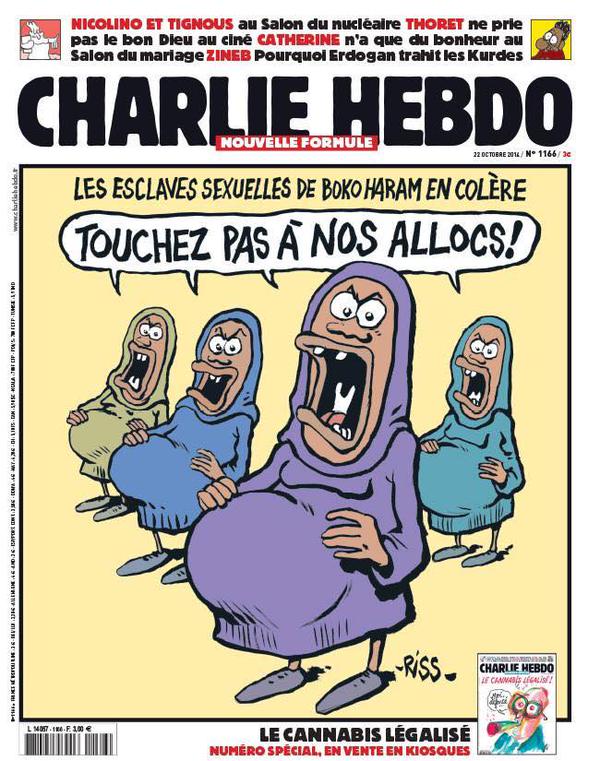
Another image consistently cited on twitter and in articles, is a CH cover depicting pregnant women shouting “leave our welfare checks alone!”, accompanied by the caption ‘Boko Haram sex slaves are angry’. Again, many have taken this in the first degree and denounced the newspaper as sexist and xenophobic; Kitty Stryker remarks that CH is “making fun of raped girls as welfare check grabbers”.

The illustration is actually the amalgamation of two unrelated stories that were in the news at the same time; the French government cutting by half the amount of maternity leave mothers can take, and Boko Haram abducting hundreds of girls who are likely being used as sex slaves. As with the UK the notion of the ‘benefit sponge’ is ripe in France, and the image was, on the contrary, trying to suggest that immigrant women, who are in dire need of benefits, are actually much more likely to be effected by the patriarchal new laws than manipulative ‘welfare queens’. Thus the illustration is in fact, not only making a feminist statement, but also sneering at both establishment policy and the anti- immigration Front National, whilst simultaneously substantiating the now horrific conditions of Nigerian schoolgirls, through the smooth blend of two topical stories.
The illustrators of Charlie Hebdo were expecting their work to be viewed in the context of the news current at the time and by an audience able to understand the deliberate exaggerations that are making subtle but telling points. Speed and fury are evident in every mocking line. 

Making subtle telling points by gross exaggeration is, after all, the stock in trade of political cartoonists.  

That's the trouble with sarcasm. People are too liable to misunderstand and take it literally and at face value, without context and without thinking any further than the startling presentation.

That's the trouble with satire.  Some people just don't get it.


Monday, 12 January 2015

Norwich tribute to Charlie Hebdo victims

From EDP24 by Lauren Cope:

People brave wind and rain to pay their respects at Norwich tribute to Charlie Hebdo victims


On a cold, wet night people gather at The Forum in Norwich to remember the journalists, cartoonists and police officers killed in the Charlie Hebdo attack in Paris. Picture by SIMON FINLAY.

Dozens braved the wind and rain tonight to light candles and show their solidarity at a tribute held in memory of the Charlie Hebdo victims.

Charlie Hebdo victim tribute

Photo gallery

Umbrellas in hand, they gathered outside the Forum for the public tribute to remember the journalists, cartoonists and police officers killed in the attack, hostages, as well as the four French Jews killed in a Paris kosher market.

A team effort ensured that candles spelling out ‘Charlie’ shone brightly, while signs were held high and badges reading ‘Je Suis Charlie’ - a phrase adopted by those supporting freedom of expression after the attack - were worn with pride.

Organiser ClĂ©mentine Pellegrino, who moved to Norwich from Nice two years ago, said: 
My French friends and I felt like it would be good for the freedom of speech and to show the outside world that people do not want to surrender to these attacks.

There is a chance that the people in France see what we have done and we want to show our support.

This is a message of peace, and a chance to show the Muslim community that we support them.
Jenny Austin, 19, attended after hearing about the event through her friends.

The University of East Anglia student said: 
We all spoke about it and decided we should come down.

The last few days in France were shocking and we wanted to show that we do not feel intimidated.


Norwich Tribute


From organiser Clémentine Pellegrino:

Dear All

I just typed a very simple programme of today's event.
PLEASE do not see this as me wanting to take control or credit for the whole thing, this is just so that people know what to expect. thank you.
Programme for the Charlie Hebdo Tribute in Norwich, Monday 12/01/2015

18:30 : Distribution of the JE SUIS CHARLIE signs, candles and pens. we will have brought some, but of course you are welcome and encouraged to bring whatever seems meaningful to you for the vigil.

19:00 : I will do a short introduction speech with a reading of a small number of texts that I found appropriate.

Then, ANYONE who wants to speak will be encouraged to say whatever they want, provided it is peaceful, apolitical, and related to the subject matter of course.

And finally, the people who will have brought candles will be encouraged to light them, and those who will have brought pens or any other non-luminous symbolical items, encouraged to do whatever they want to expose them.

This will be followed by a minute of silence.

The press has been warned, so anybody who will want to talk to them will be more than welcome.
After all, this is not about me, you, or anyone apart from those who lost their lives in these tragic events.
After all, this tribute is to show that we are supporting them, their families, and to show the forces that will only pull us out of this misery.

Thank you.


Far-right demonstration at Norwich Station

From EDP24: 
       

Men claiming to be from the National Rebirth of Poland handing out leaflets outside Norwich Railway Station on Sunday


A group of men claiming to be from a far-right Polish nationalist group staged a demonstration at Norwich Station against the jailing of the leader of a far-right movement in Greece.

The seven men, some of whom partially hid their faces, waved flags and unfurled a banner for National Rebirth of Poland this lunchtime.

They also handed out leaflets demanding that the Greek authorities release the leader of Golden Dawn, a far-right party in Greece that many believe to be neo-Nazi.

-------------------------------------------------------------------
Some comments 

From anonymous tip-off:


Hey guys, there appears to be a group of fascists outside Norwich train station. They have a golden dawn flag and a swastika-like symbol. Some are covering their faces.

From an anonymous wit:

There's nothing more ironic than an immigrant far-right group 'coming here and...', er, defending neo-nazi anti-migrants in another country who (would) have them deported if they had their way. Weird isn't it.

And from the local far right, not-quite-as-witty East Anglian members of the moribund EDL:

Si Forster: "If they can do that why don't we we need people to give out leaflets and show others that it's alright to think like this"

Wolfie Smith: "FFS everyone's protesting on our streets other than us, the Poles ,fuckin' Palestinians, Muzzies wtf's goin' on."


Sunday, 11 January 2015

Blasphemy laws used to stifle dissent

From Global Voices (with thanks to Norfolk Humanists for link):


What Drives Blasphemy Charges in the Middle East? (It's Not Just Religion)


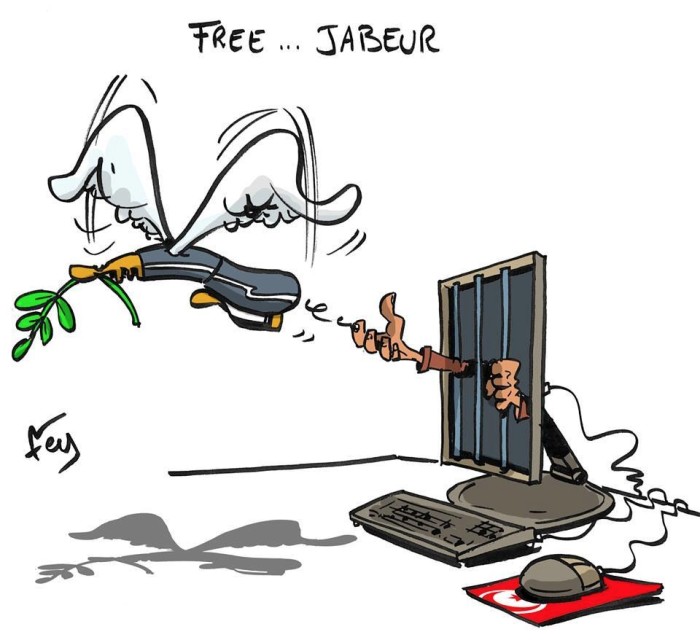
Cartoon in support of Jabeur Mejri, by Fey

Mauritanian blogger Mohamed Cheikh Ould Mohamed was sentenced to death by firing squad on December 24, 2014, for an online article he published over a year ago. This is Mauritania's first death sentence for apostasy since independence in 1960.

In the article entitled “Religion, religiosity and craftsmen,” Cheikh criticised his country’s discriminatory caste system, linking it to what he identified as similar practices from the lifetime of Prophet Muhammad. But he was accused of insulting the prophet.

“[Cheikh’s case] is merely an attempt to muzzle anyone who questions a system based on oppression by using religion as an instrument,” tweeted Mauritanian anti-slavery and racism activist Saidou Wane.

The 28-year-old man appears to be yet another victim of a repressive government in a majority Muslim country that deploys “apostasy” and “blasphemy” pretexts to crack down on those who call for reforms or speak out on political issues. By sentencing Mohamed Cheikh to death, Mauritanian authorities claim that it is Islam or Prophet Muhammad that they are trying to protect. But it is more likely that this punishment will serve only to protect the ruling regime from further political criticism.

Commenting on Cheikh's case, journalist Brian Whitaker, author of the book Arabs Without God, writes that religion has become a “political weapon” in Mauritania:

The strange thing about laws against apostasy and blasphemy is that most of the people who fall foul of them are neither apostates nor intentional blasphemers. In practice these laws have very little to do with theology and are mostly used as a pretext for settling political scores or pursuing personal grudges.

Using religion as “a pretext for settling political scores”
Whitaker indeed points to a broader trend across the Arab world. Saudi Arabia and Tunisia, which differ widely both politically and culturally, have seen similar cases in recent years.

Under a theocratic system of government, like that of Saudi Arabia, the lines that separate the religious from the political are blurred. As a result, those who question the status quo or criticize the authorities can face serious accusations on religious (not political) grounds.

How does a regime get rid of political opponents and critics in countries where religion plays an important role in the lives of the majority? One way is to throw them in jail and say they insulted Islam and its Prophet. That way (almost) no one will come to their rescue.


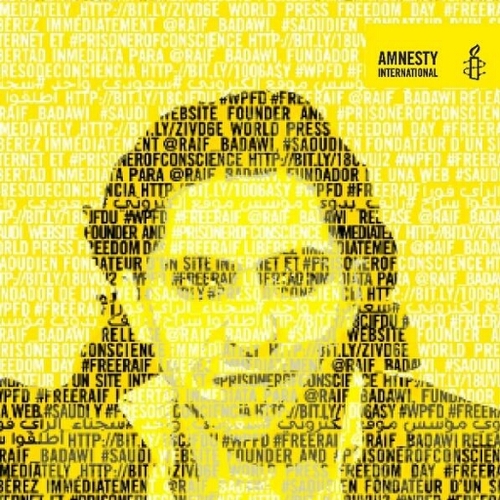
Raif Badawi campaign image by Amnesty International.

Last spring, Saudi Arabia sentencedblogger Raif Badawi to 10 years in prison and 1000 lashes for “insulting Islam” after he launched Saudi Liberals, a website hosting content critical of the country’s senior religious figures and its religious police. The site did not focus on Islam per se, but rather on specific political and religious figures and their actions. Nevertheless, Badawi was convicted of “insulting Islam.”

Saudi women's rights activist Souad al-Shammari posted tweets critical of her country’s male guardianship system, whereby a woman must have the permission of a male guardian to engage in various aspects of her life such as travel, work, and marriage. She stands accused of mocking religious texts and religious scholars.

In Tunisia, which does not have laws that criminalize blasphemy or apostasy, Internet users Jabeur Mejri and Ghazi Beji were sentenced in 2012 to seven and half years in prison over the publication of Prophet Muhammad cartoons on the web. It is worth noting that Mejri and Beji were ordinary Internet users — they were not political activists.

Beji was spared imprisonment as he fled the country before his arrest. However, Mejri spent two years in prison before he was released earlier this year when the former interim President Moncef Marzouki pardoned him.
Blasphemy is not a crime. Freedom of choice is very clear in the Quran; it says ‘let there be no compulsion in religion,’ -
Rached Ghannouchi, head of the Islamist Ennahdha Movement in Tunisia, said at an event in Washington D.C. in June 2013.

But Ghannouchi made this statement in Washington D.C. — not in Tunisia. Why didn’t Ghannouchi say “blasphemy is a not a crime” when Mejri was thrown in jail or when his party proposed a law to criminalize “insults to the Sacred”? Along with self-proclaimed Tunisian seculars’ and ‘leftists, Ghannouchi did not speak out in favor of Mejri’s release for fear of a backlash from a conservative population and turning away potential voters.

What does the Quran say about blasphemy?  
These governments also seem to ignore the fact that while Islam does not encourage blasphemy, it does tolerate it. In fact, the Quran does not prescribe a punishment for it.

Prophet Muhammad and his early followers faced persecution and ill-treatment by their contemporaries, including insults, mockery and defamation. But the Quran instructed them to be patient and simply turn away from blasphemous conversations, rather than to condemn them. 
…And you will surely hear from….those who associate much abuse with Allah. But if you are patient and fear Allah – indeed, that is the matter [worthy] of determination. [chapter 3, verse 186]

And when you see those who engage in [offensive] discourse concerning Our verses, then turn away from them until they enter into another discourse. [chapter 6, verse 68]
It is the same for apostasy. The Quran does not prescribe any worldly punishment for those who decide to convert from Islam to another religion or no religion at all. “Let there be no compulsion in religion” and “the truth is from your Lord, so whoever wills – let him believe; and whoever wills – let him disbelieve,” the Quran states.

It seems clear in the Quran that apostasy and blasphemy do not require punishments such as the death penalty or lashing — yet authorities in countries like Mauritania, Saudi Arabia and Iran continue to do the opposite. It seems the motive is more rooted in politics than religion.
Tunisian blogger Khaoula Frehcichi wrote in a blog post:
Arab rulers act as if Islam is in danger…maybe they are afraid of the collapse of their thrones.  They know very well that criticising the religious institution is the first step to unsettle their regimes.


Blasphemy and the law of fanatics

From The Washington Post by Fareed Zakaria:

A man holds a Charlie Hebdo's front page reading "Muhammad overwhelmed by fundamentalists ; It's hard to be loved by fools" during a gathering in front of the city hall of Rennes, western France, on January 7, 2015. (Damien Meyer/AFP/Getty Images)

As they went on their rampage, the men who killed 12 people in Paris this week yelled that they had “avenged the prophet.” They followed in the path of other terrorists who have bombed newspaper offices, stabbed a filmmaker and killed writers and translators, all to mete out what they believe is the proper Koranic punishment for blasphemy. But in fact, the Koran prescribes no punishment for blasphemy. Like so many of the most fanatical and violent aspects of Islamic terrorism today, the idea that Islam requires that insults against the prophet Muhammad be met with violence is a creation of politicians and clerics to serve a political agenda.

One holy book is deeply concerned with blasphemy: the Bible. In the Old Testament, blasphemy and blasphemers are condemned and prescribed harsh punishment. The best-known passage on this is Leviticus 24:16 : “Anyone who blasphemes the name of the Lord is to be put to death. The entire assembly must stone them. Whether foreigner or native-born, when they blaspheme the Name they are to be put to death.”

By contrast, the word blasphemy appears nowhere in the Koran. (Nor, incidentally, does the Koran anywhere forbid creating images of Muhammad, though there are commentaries and traditions — “hadith” — that do, to guard against idol worship.)Islamic scholar Maulana Wahiduddin Khan has pointed out that “there are more than 200 verses in the Koran, which reveal that the contemporaries of the prophets repeatedly perpetrated the same act, which is now called ‘blasphemy or abuse of the Prophet’ . . . but nowhere does the Koran prescribe the punishment of lashes, or death, or any other physical punishment.” On several occasions, Muhammad treated people who ridiculed him and his teachings with understanding and kindness. “In Islam,” Khan says, “blasphemy is a subject of intellectual discussion rather than a subject of physical punishment.”

Somebody forgot to tell the terrorists. But the gruesome and bloody belief the jihadis have adopted is all too common in the Muslim world, even among so-called moderate Muslims — that blasphemy and apostasy are grievous crimes against Islam and should be punished fiercely. Many Muslim-majority countries have laws against blasphemy and apostasy — and in some places, they are enforced.

Pakistan is now the poster child for the anti-blasphemy campaign gone wild. In March, at least 14 people were on death row in that country, and 19 were serving life sentences, according to the U.S. Commission on International Religious Freedom. The owner of the country’s largest media group has been sentenced to 26 years in prison because one of his channels broadcast a devotional song about Muhammad’s daughter while reenacting a wedding. (Really.) And Pakistan is not alone. Bangladesh, Malaysia, Egypt, Turkey and Sudan have all used blasphemy laws to jail and harass people. In moderate Indonesia, 120 people have been detained for this reason since 2003. Saudi Arabia forbids the practice of any religion other than its own Wahhabi version of Islam.

The Pakistani case is instructive, because its extreme version of anti-blasphemy law is relatively recent and a product of politics. Mohammed Zia ul-Haq, Pakistan’s president during the late 1970s and 1980s, wanted to marginalize the democratic and liberal opposition, and he embraced Islamic fundamentalists, no matter how extreme. He passed a series of laws Islamizing Pakistan, including a law that recommended the death penalty or life imprisonment for insulting Muhammad in any way.

When governments try to curry favor with fanatics, eventually the fanatics take the law into their own hands. In Pakistan, jihadis have killed dozens of people whom they accuse of blasphemy, including a brave politician,Salmaan Taseer, who dared to call the blasphemy law a “black law.”

We should fight terrorism. But we should also fight the source of the problem. It’s not enough for Muslim leaders to condemn people who kill those they consider as blasphemers if their own governments endorse the idea of punishing blasphemy at the very same time. The U.S. religious freedom commission and the U.N. Human Rights Committee have both declared that blasphemy laws violate universal human rights because they violate freedom of speech and expression. They are correct.

In Muslim-majority countries, no one dares to dial back these laws. In Western countries, no one confronts allies on these issues. But blasphemy is not a purely domestic matter, of concern only to those who worry about countries’ internal affairs. It now sits on the bloody crossroad between radical Islamists and Western societies. It cannot be avoided anymore. Western politicians, Muslim leaders and intellectuals everywhere should point out that blasphemy is something that does not exist in the Koran and should not exist in the modern world.


Fareed Zakaria writes a foreign affairs column for The Post. He is also the host of CNN’s Fareed Zakaria GPS and a contributing editor for The Atlantic.


Saturday, 10 January 2015

Norwich plans public tribute to Charlie Hebdo victims

From EDP24


A public gathering will be held in the city on Monday in memory of the victims of the Charlie Hebdo shooting in Paris.

People are being asked to assemble outside the Forum at 6.30pm to remember the journalists, cartoonists and police officers killed in Wednesday’s attack.

Organiser Clementine Pellegrino said the event would be one of “peace and mind-opening” and demonstrate people in Norwich “are not ready to accept censorship and a dominant thought.”

She added: 

Help us in the battle against extremism, and help us give the Muslim community our support in this time of need.


From the Islamic Society of Britain


Friday, 9 January 2015

Party leaders unite to decry ‘point-scoring’ by Farage

From The Independent by ANDREW GRICE :

Nigel Farage was accused of trying to score political points after blaming the terrorist attack in Paris on “multiculturalism”.

In a rare show of unity, the Conservative, Labour and Liberal Democrat leaders condemned Mr Farage for saying the atrocity was the result of “having a fifth column” in Western countries, opposed to their ideals.

The Ukip leader told LBC radio yesterday: “We in Britain, and I’ve seen evidence in other European countries too, have pursued a really rather gross policy of multiculturalism. We have encouraged people who come from different cultures to remain within those cultures, and not to integrate fully within our communities.”

Responding during a visit to Manchester, David Cameron said: 

Today is not the day to make political remarks or arguments. Today is the day to stand four-square behind the French people.
Theresa May, the Home Secretary, said: “I think it is irresponsible to talk about a fifth column.” She said everybody should work to “ensure that we deal with and eradicate extremism, wherever it exists”.

Eric Pickles, who is responsible for integration as Communities Secretary, said: 
All free societies are vulnerable to this type of attack and it is utterly wrong for any politician to be making political points when our neighbours in France are grieving. If we fight among ourselves or see our neighbours of any faith as the enemy, then the only winners are the gunman.
Deputy Prime Minister Nick Clegg told LBC that he was dismayed that Nigel Farage’s “first reflex is to make political points. To immediately imply that many, many British Muslims – who I know feel fervently British but also are very proud of their Muslim faith – are somehow part of the problem rather than part of the solution is firmly grabbing the wrong end of the stick.”

Ed Miliband, the Labour leader, said: 
I don’t think Nigel Farage or anyone else should be seeking to divide us in this way .... The most important thing for now is that we are united and stand in solidarity with the people of France.
Dame Tessa Jowell, the former Labour Cabinet minister, tweeted: 
Sickening comments from Nigel Farage. The murder of innocent people is criminal plain and simple.


Wednesday, 7 January 2015

Three UKIP members forged dozens of signatures on electoral forms, court hears

From EDP24 by Ben Kendall: 

Former UKIP councillor Matthew Smith.

Three UKIP members “cut corners” and fell short of the conduct expected of elected representatives as they forged dozens of signatures on electoral forms, prosecutors have said.

Matthew Smith, 27, the Norfolk County Council member for Gorleston St Andrews - who had been selected to stand for parliament in Great Yarmouth at the next general election, is one of three men standing trial at Norwich Crown Court over the alleged electoral fraud.

The charges relate to county council elections in the Yarmouth area in May 2013, when Smith stood for election and acted as UKIP’s electoral agent.

Today, prosecutor Brett Weaver outlined evidence of forged signatures on seven out of eight forms submitted by the party in that campaign.

He added: “These defendants were engaged in an electoral fraud on a significant scale either to gain election for themselves or others.”

On some of the forms, more than half of the signatures were forged - while one consisted entirely of fake signatures.

The signatures bore no relation to those of the individuals involved and it was “abundantly plain” they were fake, Mr Weaver said.

One features the name David McCulloch, who died shortly after the election. He was dyslexic and as a result signed his name with particular care.

When contacted by police, his daughter was easily able to confirm that it was not his signature, the court heard.

Jonathan Childs, who was the UKIP candidate for East Flegg in that election, himself raised concerns after his form was submitted without him signing it or ever seeing it.

Others whose names were fraudulently included said they would never have agreed to sign the papers.


Mr Weaver said: “This case is not a witch hunt against UKIP or its supporters.

“What this case involves is a few individuals who sought to cut corners and submits false forms to the authorities.

“It does not matter if they are Labour, Conservative or Monster Raving Loony party members.

“Those who stand for election are expected to behave with the highest levels of integrity and probity.”

Smith was elected in the 2013 poll and his own nomination slip is said to have contained forged details.

Two other men - UKIP member Michael Monk and Daniel Thistlethwaite, who stood as a candidate in the West Flegg ward for the same election - are also on trial.

As well as Gorleston St Andrews and West Flegg, nominations in the Caistor, East Flegg, Magdalen and Yarmouth Nelson and Southtown divisions were implicated.

Under electoral rules, all candidates standing in council elections must obtain 10 nominations from members of the public.

Smith, of High Street, Gorleston, has denied six counts of making a false statement in nomination papers knowing that they contained false signatures and three of making false nomination papers.

Monk, 60, of Freeman Close, Hopton, and Thistlethwaite, 19, of Station Road South, Belton, pleaded not guilty to one charge of making a false statement in nomination papers.

Smith has since stood down as the UKIP’s prospective parliamentary candidate for Yarmouth and is suspended by the party.


Wednesday, 3 December 2014

First Norwich Global Village Market


Come visit The Forum on Friday and Saturday
for goods from all over the world -